Road To Nowhere
Well we know where we're going
But we don't know where we've been
And we know what we're knowing
But we can't say what we've seen
And we're not little children
And we know what we want
And the future is certain
Give us time to work it out
Yeah
Jindřich Janíček likes to use the lyrics of the songs he likes, mostly those that surround him, and so it is a good idea to surround oneself with them in a text reflecting on his last year's works.
Let's consider them a clue, another piece of the puzzle of how to understand not only the original impulse to tell a story but Janíček’s illustrations in general. We should probably be talking about drawing or illustration, but let's try for a moment to talk about narrative, that neglected part of the illustration. Jindřich, who draws all the time and is gradually rethinking his style, is first and foremost a storyteller. For him, the primary reason to tell a story always comes before drawing, a phenomenon that is rare, unappreciated and mostly unseen here.
The unseen storyteller and the seen illustrator. It could end with this sentence.
Coincidentally, when he was about to receive his first Illustrator of the Year award, he was in the places one of the books for which he is nominated this year narrates about. Where he will be at the time of this year’s awards ceremony is not yet known.
The seated illustrator's movement is another piece of the puzzle. It's not just the movement as in a movement to the place of the narrative, but a constant movement within the narrative.
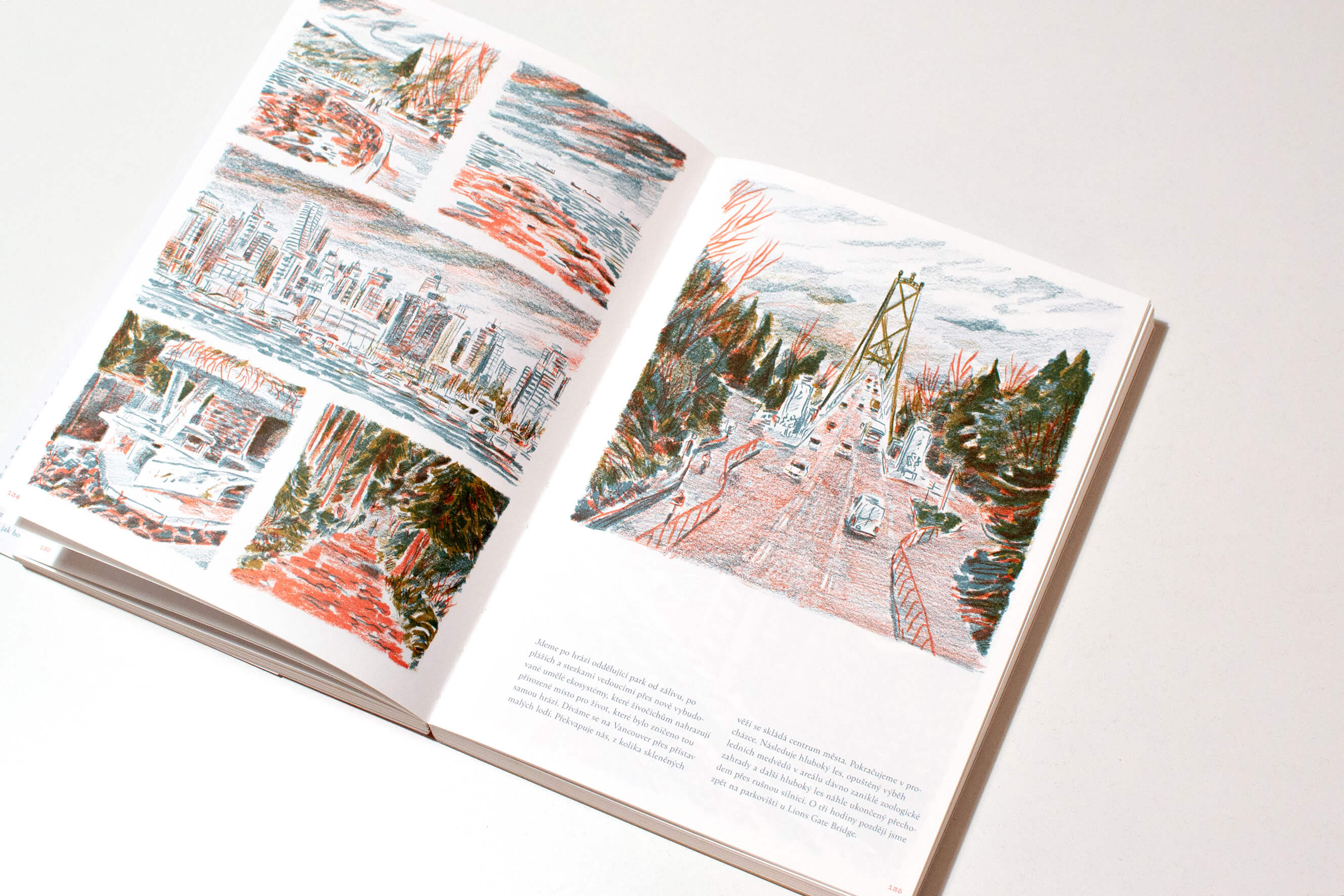
What began with the thin volumes of Zbytečné reportáže has grown to more than 300 pages of Na západ severozápadní linkou, an unassuming travelogue drawn on the road. Visually so similar to photographer Stephen Shore's books, only the narrative is different; it is the narrative of a European influenced by the visual identity of a country that influenced him more than that of his own country. The way in which Jindřich finds a home there is a situation that has befallen many, and like many Europeans before him, he is not lost there, but instead brings back what we have seen and known before, only in a different way.
Then there is only the refrain:
We're on a road to nowhere
Tomáš Luňák


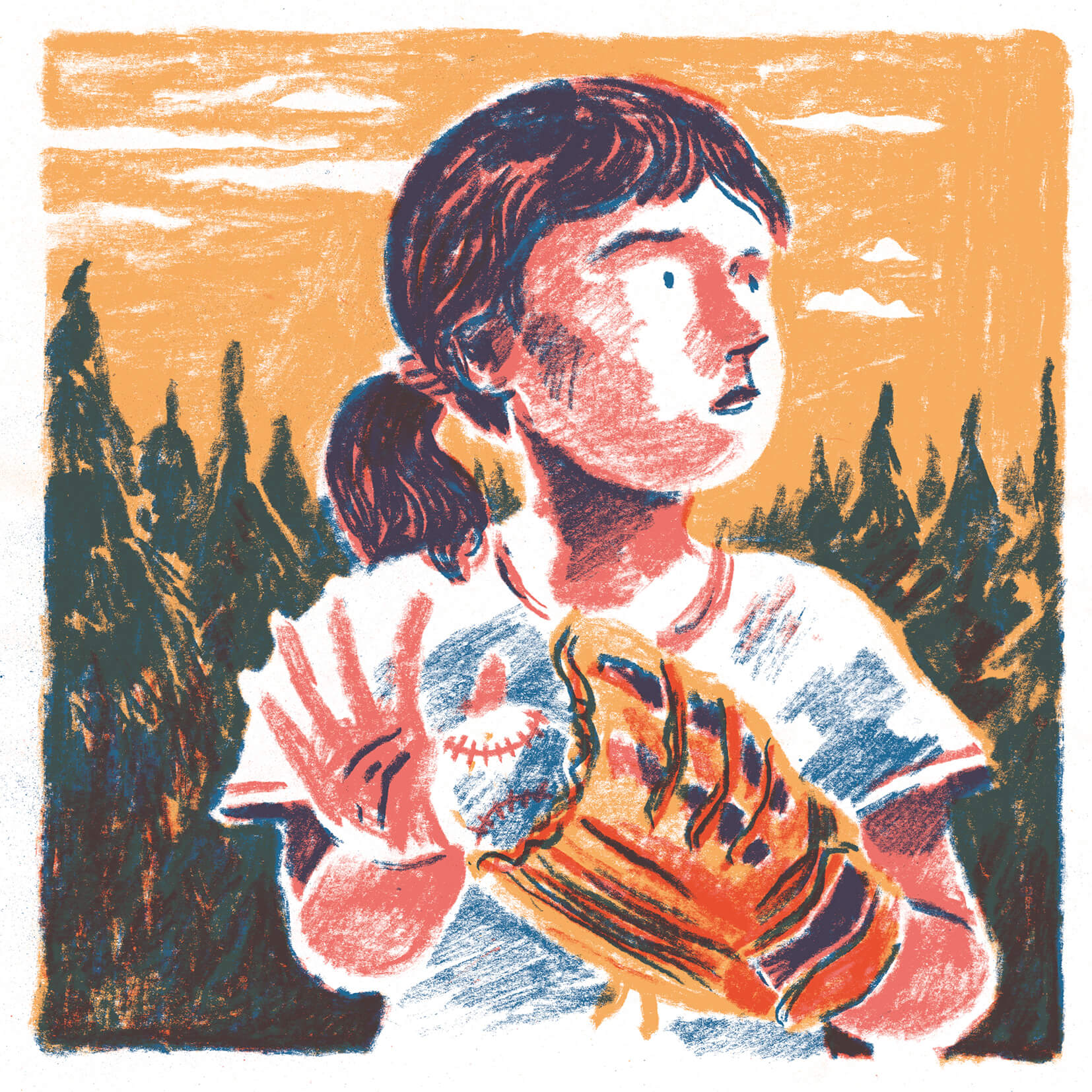
If you are unlucky enough to have not heard about the person named Jindřich Janíček aka Lokomotiva JJ in the recent years, be sure you will definitely hear about him very soon. He graduated from the Tomas Bata University in Zlín and the Studio of Illustration at the Academy of Arts, Architecture and Design in Prague. Janíček and his partner, the graphic designer Nikola Klímová, are the figures behind the Take Take Take graphic studio and publishing house, under which they have already published 17 titles. They established it out of their passion for high-quality graphic design of books and their fascination by the simplicity of book covers published in the past. However, Jindřich is mainly an illustrator who does not cease astonishing the Czech Grand Design jury for the Illustrator of the Year award by his continuous zeal and cooperation on various projects during the year - from the illustrations for the articles published in the Hospodářské noviny daily and his author's posters to his comic books and book publications. His peculiar morphology, characteristic of minimalist approach and mostly employing merely two colors multiplied one over another, became clearly distinctive for many due to its consistency and style. Janíček was this time nominated for, among other works, his comic supplement of the runner's magazine, B, entitled 75 Degree Fahrenheit. It is an illustrated story of the 1982 Boston Marathon. In late 2018, he moreover co-published and illustrated – perhaps for the first time in the history of the Czech Constitution – a synoptic and beautiful Illustrated Book of the Constitution of the Czech Republic. He conceived it in the same way he daily sees the world around him, which involves both positive and negative moments and accidents. At the point of writing this text, the publication is sold out already. I am curious about and looking forward the next stop of the JJ train, ceaselessly dashing at full speed.
František Kast


Everything important is in the sketchbook and Janíček keeps sketching incessantly. You actually cannot spot him not sketching. This obsession is important. Here they come more and more of those sketches, which are thus increasingly visible. The recent years perhaps have not seen as fertile an illustrator as this. Is this the goal and the destiny? Janíček's subjects span such a wide range that the author, jumping back and forth between the past and the future, keeps forgetting about the present; and indeed, he only rarely comments on the latter. He is rather an archive keeper of forgotten family archives, carelessly dropped and trampled comics and hollowed landscapes. Not to mention that he does not quite fit into the Czech territory anyway, being more a member of the family of illustrators occupying the New Yorker magazine covers: there is always more of the American than the Czech in his work. Is there really so little space here, is it really what we lack so heavily? Is it in the distance? Distance, however, is not the only thing present in his drawings. This seeking space perhaps merely answers the question why Janíček's production is so vast. It can also be that it is based on nostalgia over the times when one could well do with a pencil and a screwdriver.
Tomáš Luňák